

TL;DR
- AI algorithms learn patterns from data instead of following preset rules, enabling predictions and automation across industries
- Major types include supervised learning (prediction), unsupervised learning (pattern detection), and reinforcement learning (decision optimisation)
- 78% of organisations now use AI in at least one business function, with companies achieving an average ROI of £3.70 for every pound spent
- 2025 focuses on agentic AI that can autonomously handle multi-step tasks and improve transparency through explainable AI
What Are AI Algorithms and Why Do They Matter?
Artificial intelligence algorithms represent one of the most transformative technologies of our time. Unlike traditional computer programs that follow fixed instructions, AI algorithms can learn, adapt, and make decisions based on detectable data patterns.
Think of a traditional algorithm as a recipe. You follow the exact steps to bake a cake, and the outcome is predictable every time. An AI algorithm, however, resembles teaching someone to cook by showing them hundreds of successful dishes. They learn the underlying principles and can then create new recipes independently.
Recent McKinsey research shows that 78% of organisations use AI in at least one business function, marking a significant jump from previous years. This surge reflects AI’s proven ability to automate complex tasks, enhance decision-making, and create new possibilities for innovation.
The business impact is measurable. Companies using AI report average returns of £3.70 for every pound invested, with some achieving returns as high as £10.30 per pound. This financial success stems from AI’s capacity to process vast amounts of information at superhuman speed whilst identifying patterns invisible to human analysis.
From Netflix recommendations to fraud detection systems, AI algorithms power daily experiences. Understanding how they work helps you recognise opportunities to leverage this technology in your context.
Read our article on the Characteristics of Artificial Intelligence

How Do AI Algorithms Differ from Traditional Programming?
The fundamental difference between AI algorithms and traditional programming lies in how they acquire their logic. Traditional software operates through explicit instructions written by programmers. Every possible scenario must be anticipated and coded in advance.
AI algorithms take a radically different approach. Instead of programming every rule, developers provide examples of inputs and desired outputs. The algorithm then identifies patterns within this training data and builds its decision-making framework.
Consider email spam detection. A traditional approach would require programmers to write thousands of rules: “If the subject contains ‘URGENT’, flag as spam” or “If sent from an unknown domain, check further criteria”. This becomes impossibly complex as spammers constantly evolve their tactics.
An AI spam filter learns differently. Show it 100,000 emails labelled as “spam” or “legitimate”, and it discovers its indicators of suspicious messages. Spam emails typically use certain word combinations, have unusual sender patterns, or contain specific formatting quirks humans wouldn’t easily spot.
This learning capability enables AI to tackle problems where rules are unclear or constantly changing. Stock market analysis, medical diagnosis, and customer behaviour prediction involve too many variables for manual rule-writing.
The trade-off is predictability. Traditional programs always produce identical outputs for identical inputs. AI algorithms make probabilistic decisions based on learned patterns, meaning they can occasionally make mistakes but often identify solutions humans would miss.
What Types of AI Algorithms Exist?
Supervised Learning: Learning with a Teacher
Supervised learning represents the most straightforward AI approach. These algorithms learn from labelled examples, where each input has a known correct answer.
Classification algorithms predict categories. Will this customer purchase our product? Is this email spam? Will this patient develop diabetes? They examine features in the data and assign items to specific groups.
Regression algorithms predict numerical values. What price should we set for this product? How much revenue will we generate next quarter? What’s the expected customer lifetime value? They analyse relationships between variables to forecast specific numbers.
Popular supervised learning methods include:
- Decision trees create flowchart-like structures that are easy to understand and explain
- Random forests combine multiple decision trees for improved accuracy
- Neural networks use interconnected nodes to model complex relationships
Unsupervised Learning: Finding Hidden Patterns
Unsupervised learning algorithms explore data without predetermined answers. They identify hidden structures, relationships, and groupings that humans might overlook.
Clustering algorithms group similar items. Amazon uses clustering to identify customer segments: “frequent bulk buyers”, “price-sensitive shoppers”, or “brand loyalists”. These segments enable targeted marketing strategies.
Association rule mining discovers relationships between different items. A classic example is that customers who buy nappies often buy beer (possibly tired parents treating themselves). This insight drives product placement and promotional bundling decisions.
Reinforcement Learning: Learning Through Trial and Error
Reinforcement learning trains AI agents to make optimal decisions through experience. The algorithm tries different actions, receives feedback through rewards or penalties, and gradually improves its strategy.
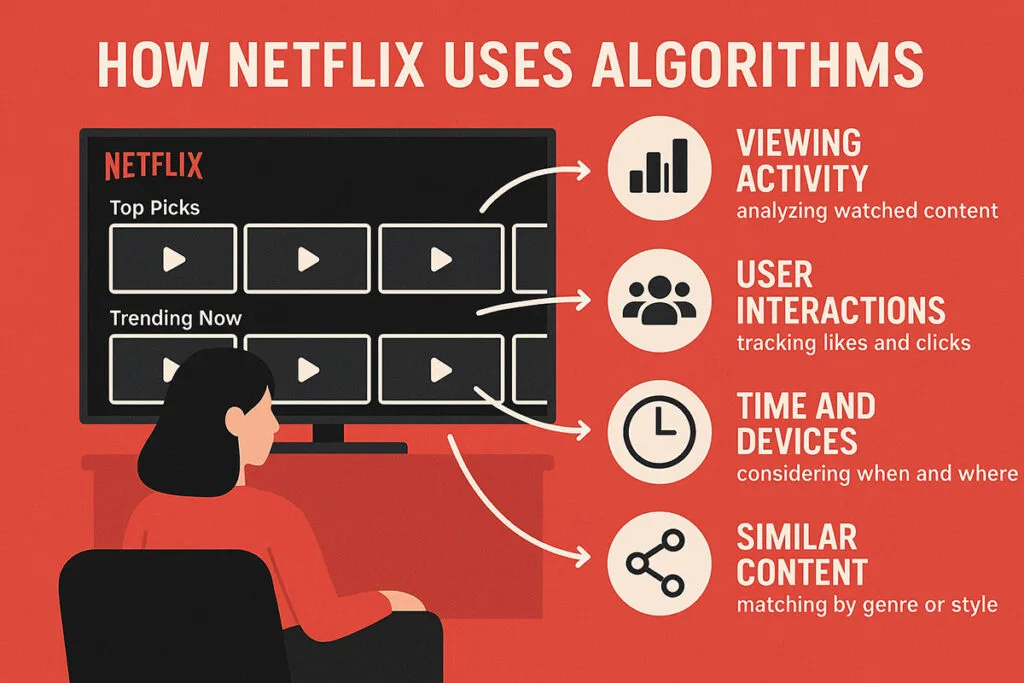
This approach powers dynamic pricing systems that adjust costs based on demand, supply, and competitor behaviour. It also drives recommendation engines that learn from user clicks, purchases, and time spent viewing content.
Game-playing AI like AlphaGo uses reinforcement learning to master complex strategies through millions of practice games, eventually discovering tactics that surpass human expertise.

How Do AI Algorithms Work? A Step-by-Step Breakdown
The AI development process follows a structured approach that transforms raw data into intelligent decision-making systems.
Data Collection and Preparation
Everything begins with data. AI algorithms require large volumes of relevant, high-quality information to learn effectively. Data that could include customer transaction records, website user behaviour, sensor readings from machinery, or historical sales data.
Data preparation consumes significant time and effort. Raw information often contains errors, missing values, duplicates, and inconsistencies. Data scientists clean these datasets, handle missing information, and convert everything into formats that algorithms can process.
The prepared data gets divided into distinct portions: training data (typically 70-80%) teaches the algorithm, validation data (10-15%) helps tune its performance, and test data (10-15%) provides an unbiased evaluation of final accuracy.
Model Training and Optimisation
During training, the algorithm examines thousands or millions of examples, gradually adjusting its internal parameters to recognise patterns. This process can require substantial computational power, particularly for complex deep-learning models.
The algorithm makes predictions on validation data, compares these against known correct answers, and calculates error rates. It then adjusts its approach to reduce mistakes, repeating this cycle until performance stabilises.
Deployment and Monitoring
Successful models integrate into live business systems, processing new data and making real-time decisions. However, deployment marks the AI lifecycle’s beginning, not the end.
Performance monitoring ensures algorithms maintain accuracy as conditions change. Customer behaviour evolves, market dynamics shift, and new patterns emerge. Without ongoing attention, even excellent models can deteriorate over time.
This iterative nature distinguishes AI development from traditional software engineering. Rather than building a finished product, teams conduct scientific experiments to test whether effective solutions can be created.
Where Are AI Algorithms Used in Business Today?
Customer Experience and Marketing
Marketing and sales represent the most common AI applications in business today, driven by the algorithms’ ability to personalise experiences at scale.
Recommendation engines analyse browsing history, purchase patterns, and user preferences to suggest relevant products. Netflix attributes over 80% of content consumption to its AI-powered suggestion system, demonstrating how effective personalisation drives engagement and reduces customer churn.
Chatbots and virtual assistants handle customer inquiries 24/7, resolving common questions instantly while escalating complex issues to human agents. Natural language processing enables these systems to understand context and provide helpful responses across multiple communication channels.
Dynamic pricing algorithms adjust costs in real-time based on demand, competitor pricing, inventory levels, and customer behaviour. Airlines, hotels, and ride-sharing services use these systems to optimise revenue while maintaining competitive positioning.
Financial Services and Risk Management
Financial institutions increasingly rely on AI for fraud detection, with 69% of enterprises considering it crucial for cybersecurity. Machine learning models analyse transaction patterns, identifying suspicious activities that would be impossible to detect manually.
Credit scoring algorithms evaluate loan applications using hundreds of data points beyond traditional credit history, enabling more accurate risk assessment while expanding access to credit for previously underserved populations.
Algorithmic trading systems execute millions of transactions per second, identifying market opportunities and managing risk across global markets. These systems process news feeds, economic indicators, and price movements to make split-second investment decisions.
Healthcare and Scientific Research
AI algorithms accelerate medical diagnosis by analysing medical images with expert-level accuracy. Radiology systems detect early signs of cancer, neurological conditions, and other diseases, enabling faster treatment and improved patient outcomes.
Drug discovery benefits enormously from AI’s pattern recognition capabilities. Algorithms can screen billions of potential compounds and predict molecular behaviour, significantly reducing the time and cost of bringing new treatments to market.
Predictive analytics helps hospitals manage resources more effectively. They forecast patient admission rates, identify high-risk patients, and optimise staff scheduling.
Operations and Supply Chain Management
Manufacturing companies use predictive maintenance algorithms to forecast equipment failures before they occur. These systems schedule maintenance during planned downtime by analysing sensor data from machinery, reducing costly unexpected breakdowns.
Supply chain optimisation leverages AI to manage inventory levels, predict demand fluctuations, and coordinate logistics across global networks. This reduces waste while ensuring products reach customers efficiently.
Quality control systems use computer vision to inspect products faster and more accurately than human inspectors, identifying defects that might otherwise reach customers.

What Are the Benefits and Challenges of Using AI Algorithms?
Key Benefits for Businesses
Enhanced Efficiency and Productivity
Companies using AI report productivity improvements of 2.4 times compared to their peers, achieved by automating repetitive tasks and accelerating decision-making processes.
AI consistently handles high-volume, routine work, freeing human employees to focus on creative, strategic, and relationship-building activities that require emotional intelligence and critical thinking.
Improved Decision-Making
AI algorithms process vast datasets to uncover insights invisible to human analysis. They identify subtle patterns, correlations, and trends that inform strategic choices more accurately and quickly than traditional methods.
Real-time analytics enables businesses to respond quickly to market changes, customer preferences, and operational issues. This agility provides competitive advantages in rapidly evolving industries.
Scalable Operations
AI systems handle increasing workloads without proportional cost increases. Customer service chatbots can manage millions of inquiries simultaneously, while fraud detection systems monitor billions of transactions in real-time.
This scalability enables businesses to grow their customer base and operational complexity without linear increases in staffing costs.
Primary Challenges and Limitations
Data Quality and Availability Issues
Approximately 70% of AI implementation challenges stem from people and process-related issues, while only 10% involve algorithm problems. Poor data quality, incomplete datasets, and information silos create significant barriers to successful AI deployment.
Historical data may contain biases that algorithms learn and amplify, leading to unfair or discriminatory outcomes. Addressing these issues requires careful data curation and ongoing monitoring.
High Implementation Costs
AI projects involve substantial upfront investments in data infrastructure, computational resources, and specialised talent. Training complex models can cost millions of pounds, whilst ongoing maintenance and updates add to the total ownership cost.
Many organisations struggle with achieving measurable ROI, particularly those that focus disproportionately on technical aspects rather than business processes.
Skills Shortage and Change Management
The demand for AI expertise far exceeds the available supply, making it expensive and challenging to build capable teams. Beyond technical skills, organisations need employees who understand how to integrate AI into existing workflows effectively.
Success requires focusing 70% of resources on people and processes, 20% on technology and data, and only 10% on algorithms.
Transparency and Trust Concerns
Many advanced AI models operate as “black boxes”, making decisions through processes that are difficult to interpret or explain. This lack of transparency challenges regulatory compliance and user trust, particularly in high-stakes applications like healthcare and finance.

What’s Next for AI Algorithms in 2025 and Beyond?
Agentic AI: The Rise of Autonomous Digital Workers
2025 marks the emergence of agentic AI systems capable of independent action and multi-step reasoning. Unlike current AI, which responds to single queries, these systems can plan and execute complex workflows and adapt their approach based on results.
Business leaders expect AI agents to double their knowledge workforce, transforming speed to market, customer interactions, and product design. These digital workers will handle routine tasks autonomously while collaborating with humans on complex challenges.
However, experts warn that most organisations aren’t yet “agent-ready” and must expose enterprise APIs and redesign workflows to maximise this technology’s potential.
Explainable AI and Responsible Development
Growing regulatory pressure and business needs drive demand for transparent, interpretable AI systems. New frameworks focus on identifying and mitigating AI risks, with organisations like OWASP expanding their risk categories to address emerging challenges.
Companies increasingly implement AI governance committees, fairness audits, and human oversight mechanisms to ensure responsible deployment. This shift treats governance not as a constraint but as an enabler of trust and sustainable growth.
Improved Efficiency and Accessibility
The future includes smaller, more efficient algorithms that run on everyday devices rather than requiring massive cloud infrastructure. Edge AI and TinyML enable real-time processing on smartphones, sensors, and factory equipment while reducing bandwidth costs and improving privacy.
Quantum AI represents another frontier, potentially solving complex optimisation problems far faster than traditional computers, though practical applications remain years away.
Democratisation Through Low-Code Platforms
Low-code and no-code AI platforms enable business users to build intelligent systems through drag-and-drop interfaces, reducing dependence on specialised technical teams.
This democratisation allows domain experts to create AI solutions tailored to their specific needs whilst accelerating adoption across organisations.
Your Next Steps with AI Algorithms
AI algorithms represent far more than a technological advancement—they’re reshaping how businesses operate, compete, and create value. From supervised learning that predicts customer behaviour to reinforcement learning that optimises complex decisions, these systems offer measurable benefits for organisations ready to embrace them strategically.
The evidence is compelling: companies using AI achieve average returns of £3.70 per pound invested, while AI adoption has grown from 20% to 78% of organisations in just seven years. This isn’t experimental technology anymore; it’s a business necessity.
Success requires moving beyond technical fascination to focus on business outcomes. Leading organisations invest 70% of their AI resources in people and processes, recognising that algorithms alone don’t create value. They start with clear problems, use quality data, and build capabilities gradually.
The future promises even greater opportunities through agentic AI, improved transparency, and accessible platforms that democratise intelligent automation. However, the organisations that begin building AI capabilities today, thoughtfully and strategically, will have significant advantages over those that wait.
Your next step shouldn’t be choosing the perfect algorithm or platform. Instead, identify one business challenge where AI could create measurable value, ensure you have quality data to support it and start building the human capabilities needed to succeed in an algorithm-driven world.